MFP Printer Purchase vs. Operating Lease: Contractual Differences and When Each Makes Sense
Condividi
Introduction
Should you buy a multifunction printer (MFP) or opt for an operating lease? The choice affects your budget, cash flow, IT management, and service continuity. In this practical, business-oriented guide, we analyze cost structure, contract flexibility, duration and renewals, and selection criteria to help you understand when purchasing is the better option and when multifunction printer leasing is. You will also find FAQs, a "key takeaways" summary, and a CTA to request a consultation.
Key Takeaways
- Purchase: higher upfront investment (CAPEX), competitive TCO over the long term if volumes are stable and the company prefers to hold the asset.
- Operating lease: predictable OPEX fee that includes services; ideal for scalability, upgrades, and cash flow planning.
- Support and supplies: often included in the lease fee; with a purchase, they must be contracted separately with a dedicated service contract.
- Duration: typically 36–60 months for a lease; pay attention to penalties and renewal/replacement conditions.
- Choice: base it on print volumes, seasonal peaks, cost governance, accounting policies, and business continuity objectives.
- Disclaimer: tax/legal aspects vary from case to case; the following does not constitute professional advice.
Cost Structure
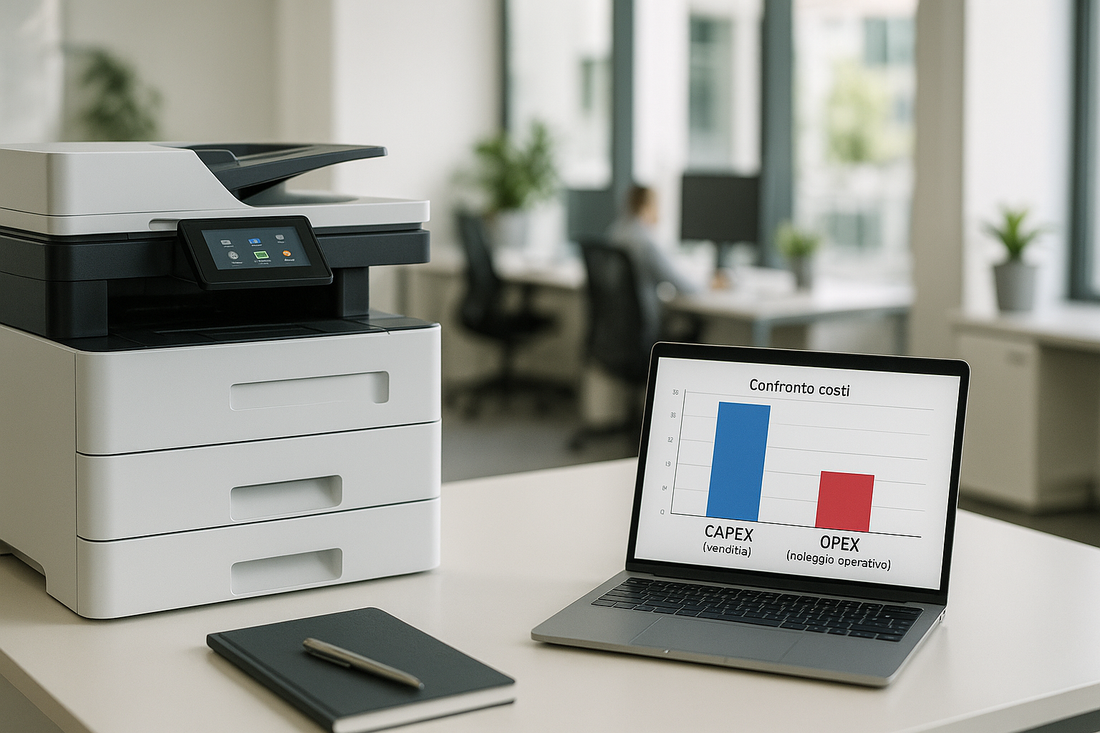
CAPEX vs. OPEX and Budget Impact
- Purchase: involves CAPEX (asset purchase). The cost is concentrated at the beginning; accounting depreciation occurs over time. For companies with liquidity and an investment policy, it can be advantageous over the long term.
- Operating lease: involves recurring OPEX. The cost is spread across monthly/quarterly fees, improving cash flow predictability and simplifying the operating budget.
Tax/legal note: accounting and tax implications depend on the company and regulatory context. This content does not constitute tax or legal advice. For formal decisions, consult your advisor.
TCO (Total Cost of Ownership)
The TCO of an MFP includes: hardware, support services, spare parts and consumables, maintenance, updates, and any managed print solutions.
- With a purchase, the TCO can be competitive if volumes are predictable and support is optimized with a cost-per-page contract.
- With a lease, the TCO is often all-inclusive: the fee covers hardware, technical interventions, consumables (excluding paper), monitoring, and SLAs, reducing unforeseen issues.
Fees and Pricing Components
In operating lease contracts, the fee may include:
- Fixed fee for asset availability.
- Included copy allowance (allowances), beyond which a cost per page applies.
- Services: installation, basic training, remote monitoring, spare parts, and response times.
With a purchase, these elements must be contracted separately through a service contract or "pay-per-page" packages.
Cash Flow and Predictability
- Purchase: higher initial outlay, lower unit cost over time if properly sized.
- Operating lease: high predictability and lower impact on capital; facilitates planning and financial flexibility, especially for SMEs and growing organizations.
Contract Flexibility
Scalability and Adaptation to Needs
- Lease: allows scalability (adding/uninstalling devices), fee realignment, and technology upgrades during the contract term. Recommended for environments with variable volumes or expanding locations.
- Purchase: less flexible; any upgrades require new acquisitions or trade-ins.
Services, SLAs, and Business Continuity
Lease contracts often include clear SLAs (response and resolution times), consumable monitoring, and a replacement machine in case of downtime, reducing the risk of downtime. With a purchase, it is essential to define SLAs and service levels in a dedicated service contract to ensure continuity.
Penalties, Termination, and Replacement
- Lease: consider early termination penalties, conditions for replacements/upgrades, and fee adjustments.
- Purchase: pay attention to the warranty, extensions, and coverage of wear-and-tear parts; any collection/disposal costs.
Duration and Renewals
Typical Durations
- Operating lease: generally 36, 48, or 60 months. Longer durations reduce the fee but increase the risk of obsolescence.
- Purchase: no contractual deadline on the hardware; coexistence depends on the life cycle, volumes, and internal depreciation policies.
Renewals and Contract End
- Lease: at expiration, you can renew, extend at a reduced fee, replace it with newer models, or return the asset. Also check automatic renewal clauses and return procedures (packaging, data erasure, counter reports).
- Purchase: plan upgrades and disposal with security and sustainability in mind; consider managed print plans to maintain efficiency and cost control.
Obsolescence and Security
The evolution of firmware, protocols, and security features makes upgradability a key element. Leasing facilitates scheduled upgrades; with a purchase, it is advisable to plan for periodic checks and update plans.
Selection Criteria
Volumes and Demand Variability
- Stable and predictable volumes - purchase + targeted service contract can maximize TCO.
- Fluctuating or seasonal volumes - lease with expandable allowances/modules to avoid over/under-sizing.
Governance and Cost Control
- Lease: cost visibility through the fee and reporting; useful for cost centers and internal chargebacks.
- Purchase: asset management control; pay attention to cost-per-page monitoring and service SLAs.
Accounting Policies and Financial Objectives
- Preference for OPEX and liquidity preservation - operating lease.
- Interest in CAPEX and depreciation - purchase.
Disclaimer: for correct accounting and tax classification, consult your advisor. This article is not advice.
Service Continuity and Support
Regardless of the arrangement, the quality of support is crucial: response times, parts availability, help desk, replacement machine, remote monitoring. Evaluate partners with managed print services and a clear support channel.
Integration and Compliance
Consider integration with document workflows, user authentication, security policies, and data management (secure erasure at end of life). Leasing simplifies upgrades; with a purchase, plan technical and software review cycles.
How to Request a Consultation or Quote
Do you need to understand whether purchasing or multifunction printer leasing is right for your company? We can help you estimate TCO, size print allowances, define SLAs , and integrate managed print services.
FAQ
What is the main difference between purchasing and an operating lease?
Purchasing requires an upfront investment (CAPEX); leasing involves OPEX fees that often include support and consumables, with greater flexibility.
Is leasing always cheaper than purchasing?
Not always. It is more predictable and flexible; purchasing can be more cost-effective over the long term with stable volumes and an efficient service contract.
Can I change machines during the lease?
Generally yes, subject to the contract terms (upgrades, replacement, fee recalibration). Check penalties and replacement procedures.
What does the lease fee include?
Typically hardware, support, spare parts, SLAs, and a copy allowance; beyond the allowance, a cost per page applies. Details vary by contract.
Is a service contract needed even with a purchase?
Yes. It is advisable to cover maintenance, spare parts, response times, and business continuity.